

Lexus Brake Service in Fresno: Inspection, Pad Replacement & Costs
Choosing the right brake pad material for your Lexus affects three things: stopping power, cabin quiet, and how clean your wheels stay. For most models, the choice comes down to how you drive. When you visit our Lexus service center, our team can match the factory-recommended compound to your habits.
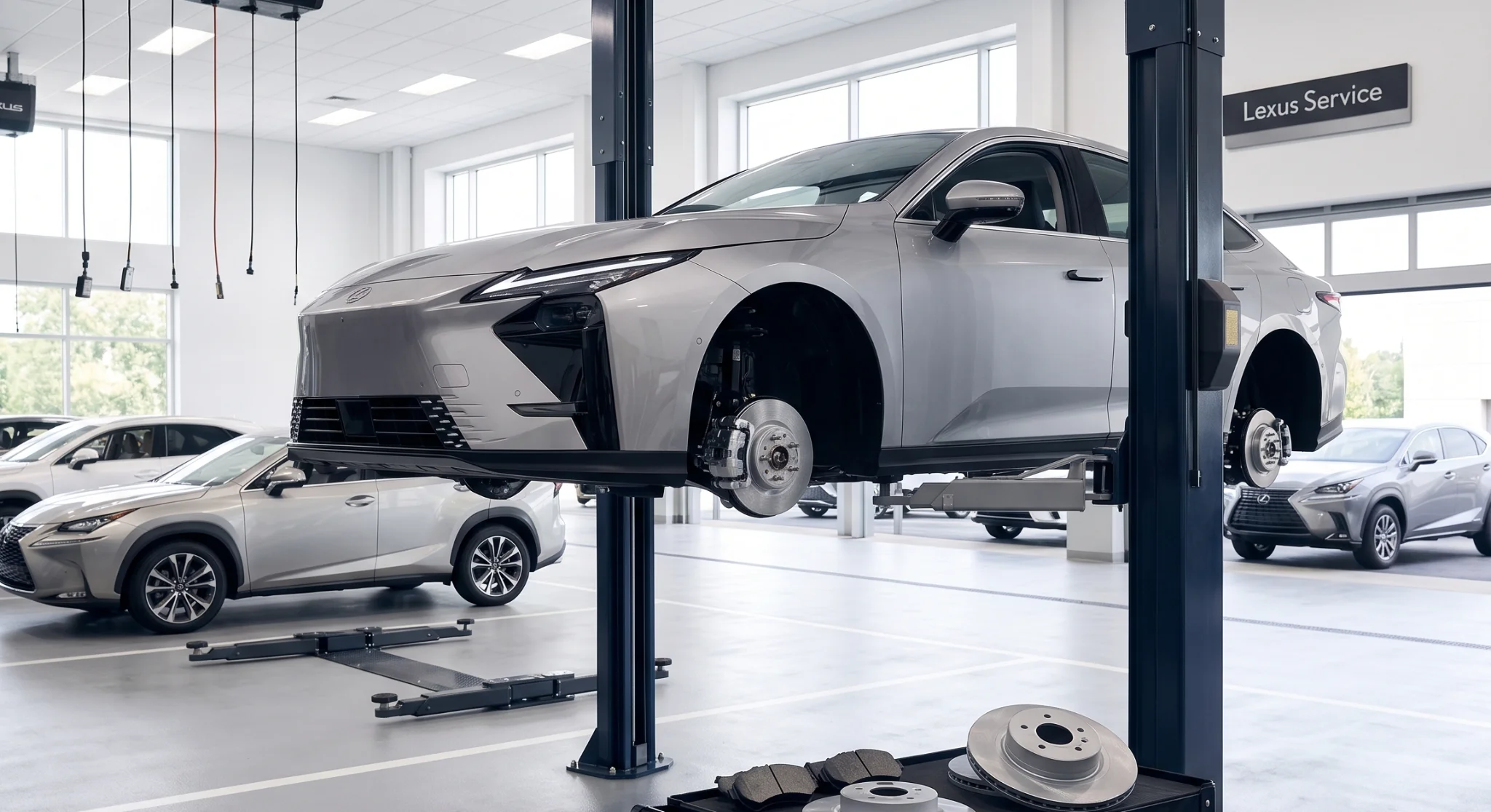
Ceramic vs. Semi-Metallic Brake Pads: Which Is Right for Your Lexus?
Ceramic pads use dense ceramic compounds with reinforcing fibers. They run quietly, produce very little brake dust, and stay gentle on your rotors. They also perform consistently in everyday driving. Under sustained extreme heat, they can lose some bite. That is because the ceramic material insulates rather than sheds heat, so they work best for normal commuting rather than repeated hard stops.
Semi-metallic pads blend iron, steel, and graphite and are defined by their high metal content. They offer stronger cold-bite and shed heat better. That suits heavy-duty use and aggressive or high-load driving. The trade-off is more brake dust and more noise.
| Attribute | Ceramic | Semi-Metallic |
|---|---|---|
| Composition | Ceramic compounds with reinforcing fibers | Iron, steel, and graphite; high metal content |
| Brake dust | Very low; light and fine | Higher; dark and gritty |
| Noise | Quietest of the common pad types | Louder, especially when cold |
| Heat & fade | Great for everyday driving; can fade under sustained extreme heat | Superior heat dissipation; more fade-resistant |
| Cold bite | Needs a brief warm-up | Excellent immediate bite |
| Rotor wear | Gentler on rotors | More abrasive on rotors |
| Best for | Daily luxury commuting | Heavy-duty use, towing, and aggressive driving |
What Drives Brake Pad Wear: Why Some Pads Reach 30,000 Miles and Others 80,000
Brake pad life usually runs from about 30,000 to 80,000 miles. How and where you drive is the biggest factor. Stop-and-go city traffic turns motion into heat over and over, which speeds up wear. Steady highway commuting is far gentler and pushes pad life toward the high end.
Vehicle weight and drivetrain matter too. Heavier vehicles put more heat load on the pads. Hybrids use regenerative braking, where the electric motor does much of the slowing and sends energy back to the battery. This eases the load on the friction brakes and often extends pad life well beyond a comparable gas model. Frequent steep grades or long downhill braking build extra heat, which can speed up wear or cause brake fade. Drivers who face those conditions should check their brakes more often. For more detail, see how long brake pads typically last.
Inside the Lexus Multi-Point Brake Inspection
A professional inspection goes well beyond a glance through the wheel spokes. Our certified technicians check the full hydraulic and mechanical stopping system against factory tolerances:
Friction Material Measurement
Precision calipers measure remaining pad thickness. New pads typically measure 10–12 mm; replacement is recommended at about 3 mm or less to avoid metal-on-metal contact.
Rotor Condition & Runout
Rotors are checked for scoring, hot spots, and rust; a dial indicator measures runout and thickness to decide whether to resurface or replace.
Caliper & Hardware
Guide pins, boots, and pistons are checked for free movement and lubrication; a seized caliper causes uneven wear and vehicle pulling.
Hydraulic Lines & Fluid
Lines are inspected for cracks and leaks, and brake-fluid moisture content is tested, since contaminated fluid lowers the boiling point and causes a spongy pedal.
Catching minor wear early prevents costly, cascading damage.
What a Complete Lexus Brake Job Costs
A complete front-and-rear brake job includes new pads, new rotors, caliper service, and hardware. The cost varies with your model and the parts it needs. A high-performance or heavy-duty model uses more robust components than a standard sedan. Labor and parts choices also affect the final invoice. For an exact figure, ask our team for a written estimate. To protect fitment, longevity, and warranty coverage, we install genuine, factory-approved Lexus parts.
Loaner Vehicles, Shuttle Service, and a Comfortable Wait
Minimizing disruption to your day is a priority. For qualifying appointments, we offer complimentary loaner vehicles and shuttle service, plus a complimentary wash with every service. Prefer to wait? Our Wi-Fi-equipped lounge has a café and a business center with charging stations. Every vehicle is serviced by Lexus factory-trained, Lexus-certified technicians. Your records also live in the Lexus National Service History database, so our team can review that history and recommend the right care.
Common Questions About Lexus Brake Care
How often should the brake fluid be replaced in a Lexus?
Lexus generally recommends a complete brake-fluid exchange around every 30,000 miles or 36 months, with condition checks at regular service intervals in between. Brake fluid absorbs moisture over time, which can cause internal corrosion and reduce stopping efficiency.
Why do my brakes squeak in the morning but quiet down once I start driving?
A thin layer of surface rust often forms on the rotors overnight from dew or humidity. It is swept away the first few times you brake, so the temporary squeak disappears quickly.
What is the difference between brake service and brake repair?
Brake service is preventive maintenance — replacing pads before they wear thin, exchanging old fluid — to keep the system working efficiently. Brake repair is corrective work to fix an existing problem, such as replacing warped rotors or a seized caliper.
Can steep or mountain driving accelerate brake wear?
Yes. Long or steep descents require prolonged, heavy braking that builds extreme heat in the pads and rotors, which can accelerate wear and cause brake fade — a good reason for regular inspections if you drive those routes often.
Schedule Your Lexus Brake Service in Fresno
Your brakes are the most important safety system on your vehicle. If you notice squealing, vibration, or longer stopping distances, don’t wait. Our factory-trained team will inspect, service, and replace components to manufacturer specifications.
The information in this article is general guidance and does not constitute a specific diagnostic or repair recommendation for any individual vehicle. Repair and maintenance decisions should be made in consultation with a certified technician based on the specific condition of your vehicle.